


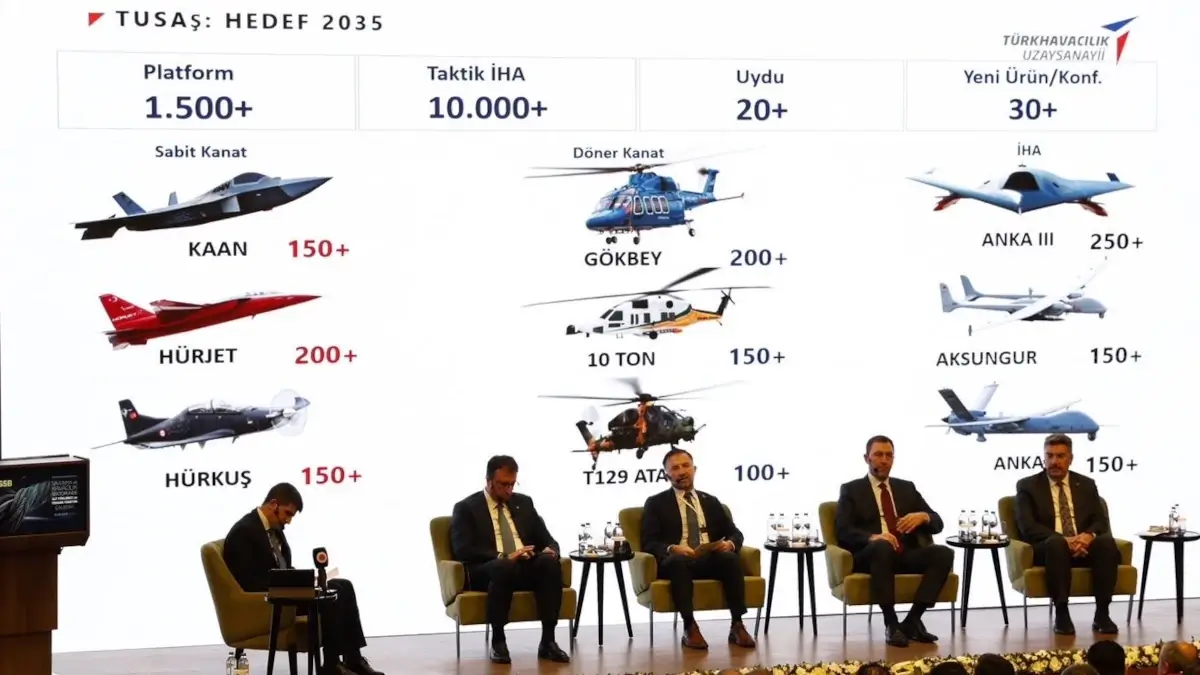
TUSAŞ has announced its roadmap for the production of domestic platforms until 2035. The strategy outlined in the announcement includes: KAAN, HÜRJET And unmanned systems There are critical production thresholds. The company's targets include over 10,000 units. tactical UAV, more than 20 satellite And there are more than 30 new product developments as well.
Fixed-Wing and Rotary-Wing Targets
TUSAŞ's 2035 targets include significant production figures for fixed-wing and rotary-wing platforms. On the fixed-wing side, more than 150 units for KAAN and more than 200 units for HÜRJET., HURKUŞ-II More than 150 units are projected for production. On the rotary wing side. GÖKBEY More than 200 for [specific], more than 150 for T925, and T129 ATAK More than 100 helicopters are targeted for this purpose.
On the unmanned aerial vehicle side, production of more than 250 units is planned for ANKA-3, along with 150 each for ANKA and AKSUNGUR. This table demonstrates that TAI aims to significantly increase serial production capacity on each platform over the next decade while maintaining platform diversity.
A Second Production Line Coming for ANKA-3
A critical development is also underway in TAI's ANKA-3 programme. It has been reported that the company has completed construction of its second ANKA-3 production line, which will open in November. The new line will produce an improved variant of the ANKA-3 with a larger fuselage and a payload capacity of approximately 1.75 tonnes. On the original platform, this capacity was around 1.3 tonnes. The first aircraft to be produced on the new line is expected to roll off the line soon and subsequently begin flight testing.
ANKA-3 is a combat UAV designed for strike and other missions. According to TAI data, the aircraft can reach high subsonic speeds and operate at altitudes of up to 40,000 feet. The Turkish Armed Forces have placed an order for 80 ANKA-3 aircraft, with the first delivery scheduled for 2027.
Export of 14 HÜRKUŞ Aircraft to Azerbaijan
TUSAŞ has added another achievement to its export successes. Azerbaijan's A contract was signed with Azerbaijan for the export of the HÜRKUŞ Advanced Training Aircraft within the scope of the ADEX 2026 exhibition held in Baku, the capital of Azerbaijan. Under the agreement, 14 HÜRKUŞ-II aircraft are planned to be delivered to Azerbaijan. The aircraft will be used in the training activities of the Azerbaijani Air Force. This export is considered a step that strengthens the presence of national air platforms in the international arena.
Why Are TAI's 2035 Targets Important?
TAI's 2035 targets are not limited to production figures alone. This picture demonstrates the level of maturity Türkiye has reached in the defence industry and the structural transformation it aims for over the next decade. The target of producing more than 150 KAAN aircraft strongly asserts Türkiye's claim to becoming a permanent player in the fifth-generation combat aircraft class. The target of producing more than 200 HÜRJET aircraft means both renewing the Turkish Air Force's training fleet and securing an ambitious position in the export market.
The target of producing more than 10,000 tactical UAVs tells an entirely different story. This figure demonstrates that Türkiye has become a country that exports not only platforms in unmanned systems, but a complete warfare concept together with its munitions, sensor and software ecosystem. The increase in the ANKA-3's payload capacity from 1.3 tonnes to 1.75 tonnes indicates that the mission spectrum of unmanned combat aerial vehicles is expanding. This capacity increase makes ANKA-3 usable not only for strike missions but also in different mission profiles such as electronic warfare and deep strike.
The HÜRKUŞ export to Azerbaijan, meanwhile, demonstrates the geographical diversity of Türkiye's export strategy in the defence industry and that its 2035 targets are achievable. This reference gained in the Turkic Republics market could also open doors for countries such as Kazakhstan, Uzbekistan and Kyrgyzstan in the period ahead. Azerbaijan's earlier acquisition of Bayraktar TB2 and its current preference for HÜRKUŞ-II show that Ankara-Baku defence cooperation is deepening by increasing platform diversity.
ATAK 2's Absence from the Plans Drew Attention
One of the most striking details in TUSAŞ's 2035 roadmap is its production planning. To the ATAK 2 helicopter yer verilmemesi. Uzun süredir ATAK 2 ile ilgili geliştirme faaliyetlerinin durduğu yönünde değerlendirmeler yapılıyordu. ATAK 2’nin üretim planlarında yer almaması projenin rafa kaldırıldığını gösterir nitelikte. Yol haritasında ATAK 2 yerine 10 ton sınıfı ağır helikopterin 150’den fazla üretimle planlamaya dahil edilmesi, Türkiye’nin ağır sınıf taarruz helikopteri ihtiyacı için farklı bir yola yöneldiğini gösteriyor. Bu tercih, mevcut ATAK platformunun geliştirilmesi yerine yeni bir ağır sınıf helikopter konseptine odaklanıldığına işaret ediyor.
The given production figures also imply that the engine issue will be resolved much earlier than these dates. The production target of more than 150 platforms for KAAN, more than 200 for HÜRJET, and more than 350 in total for GÖKBEY and the 10-ton class helicopter indicates that the engines for these platforms will reach the mass production stage before 2035. If Türkiye's engine programs, developed through TEI, meet this schedule, it will mean solving one of the most critical supply problems of the defense industry. Reducing dependence on foreign sources, especially for KAAN's engine, is a factor that will directly affect the project's export potential.
Note
If you have any photos or video footage to support our news story, please share them with us using the information provided on our contact us page.
